How to Store Pots and Pans in a Small Kitchen

The easiest way to store pots and pans in a small kitchen is to nest them by size, store the lids separately on their edges, and keep only your everyday pieces within reach of the stove. Add pan protectors between nonstick surfaces, use vertical space for flat bakeware, and move rarely used pieces to a high shelf or closet. Those few habits can free up a surprising amount of cabinet space.
Start with an honest edit
Before you buy a single organizer, pull everything out of the cabinet. Group it into three piles:
- Daily: what you used in the last week, usually a skillet, a saucepan and a sheet pan.
- Monthly: the stock pot, the roasting pan, the muffin pan.
- Rarely: the turkey roaster, holiday pans, duplicates you forgot you owned.
Daily pieces get the cabinet closest to the stove. Monthly pieces can go lower or deeper. Rarely used pieces can live on top of the fridge, in a hall closet or under the bed in a bin. Duplicates can be donated. Small kitchens get crowded less from what you use and more from what you keep "just in case."
How do you stack pots and pans without scratching them?
Nesting is the single biggest space saver. Put the largest pot on the bottom and work up by size, so a saucepan sits inside a larger pot and a small skillet sits inside a larger one.
Protect the surfaces
When cooking surfaces touch, they rub. Stainless steel and cast iron can handle some contact, but nonstick and ceramic coatings scratch more easily. Place a felt pan protector, a soft dish towel, a paper towel or a thin silicone mat between every nested piece. It takes a few seconds and helps your coatings last. Our guide to making your nonstick last has more care tips.
Watch the handles
Long handles are what usually stop pans from nesting neatly. Alternate the direction of handles as you stack, or turn the stack so the handles point toward the back of the cabinet. If you are shopping for new cookware, a set with removable handles solves the problem outright. The 15-Piece Detachable Handle Cookware Set in Dark Gray uses two detachable silicone handles, so its pots (1.8, 2.6 and 3.5 quart) can nest without handles sticking out.
Where should the lids go?
Lids balanced on top of stacked pots slide off and make it hard to reach anything. Pull them out and store them on their edges instead. A few options:
- In a drawer, upright. A deep drawer near the stove holds lids vertically like files.
- In a bin or dish rack. A plain plastic bin or an old dish drying rack inside the cabinet keeps lids standing up.
- On the cabinet door. Adhesive lid racks mounted on the inside of a door use space that is otherwise empty. Measure the door clearance first so the lids do not hit the shelves.
- Upside down on their own pot. If you only nest two pieces, flip the lid so the knob drops into the pot. The stack sits flatter.
Use vertical space for flat pieces
Cookie sheets, cutting boards, cooling racks and baking pans take up far less room standing on their edges than lying flat in a pile. Add a tension rod or a simple wire file organizer inside a cabinet to create upright slots. You will be able to slide out the one pan you need without lifting five others.
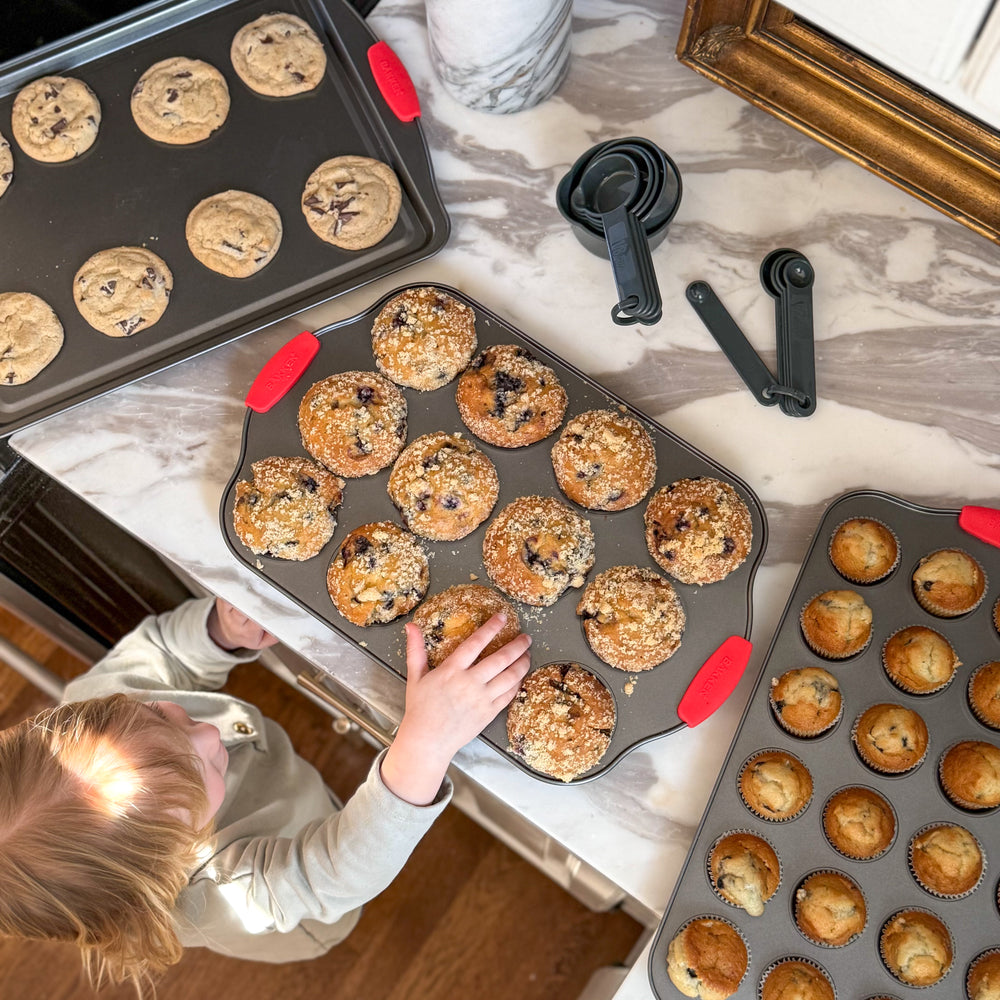
Bakeware designed to stack is another good fit for small kitchens. Stackable sets are made so the pieces nest closely together. The 6-Piece Stackable Bakeware Set in Gray, for example, is carbon steel with a nonstick gray coating inside and out, and includes two cookie sheets and a roaster pan that each measure 17.91 x 11.54 inches, plus a 10.24 x 5.12 inch loaf pan, a muffin pan and a square pan.
Shop the stackable bakeware collection for more sets that nest.
Clear the drawer next to the stove
The drawer beside your stove is prime real estate. If it is full of jumbled utensils, the tools you need end up on the counter, and the counter fills up fast. An expandable divider keeps spatulas, tongs, whisks and measuring spoons sorted so the drawer actually closes.
The 8-Slot Expandable Drawer Organizer in Gray is BPA-free PP plastic, expands from 13 to 22.4 inches wide and has 8 compartments in 3 sizes. If you want fewer, larger slots, the 5-Slot Expandable Drawer Organizer in Black expands across the same range with three 13.4 inch compartments and two 14 inch side slots. Measure the inside width and length of your drawer before you buy any divider.
Small-kitchen storage ideas at a glance
| Problem | Fix | What you need |
|---|---|---|
| Stacked pans scratch each other | Layer protectors between pieces | Felt protectors, towels or paper towels |
| Handles stop pans from nesting | Alternate handle direction or use removable handles | Nothing, or a detachable-handle set |
| Lids slide everywhere | Store upright in a drawer, bin or door rack | Bin or adhesive lid rack |
| Sheet pans are buried | Stand them on edge | Tension rod or file organizer |
| Deep cabinet is hard to reach | Add a pull-out basket or turntable | Sliding basket or lazy Susan |
| Utensil drawer will not close | Sort with a divider | Expandable drawer organizer |
| Not enough cabinets at all | Go up or out | Wall rail with S-hooks, or the oven drawer |
What if you have almost no cabinets?
Some apartment kitchens have one cabinet under the sink and little else. In that case, look beyond cabinets:
- Wall rails or a pegboard. Hang your most-used skillet and saucepan on S-hooks. It is both storage and easy access.
- The oven drawer. On many ovens, the drawer underneath is for storage, which makes it a natural home for sheet pans and baking dishes. Check your manual first, since some are warming drawers.
- Inside the oven, carefully. Some people keep a pan or two in the oven. If you do, make it a habit to check before preheating, and never leave anything with plastic or silicone parts in there.
- A rolling cart. A narrow cart can slide between the fridge and the wall and hold pots on its lower shelf.
- Above the cabinets or fridge. Good for the big stock pot or holiday roaster you use only a few times a year.
Store cast iron and stainless steel the right way
Different materials have different storage needs. Cast iron should be completely dry before you put it away, and a thin coat of oil helps protect it. A paper towel between stacked cast iron pieces absorbs moisture and helps prevent rust. Lodge recommends making sure cast iron is dry and lightly oiled for storage. Our Cast Iron 101 guide on the journal walks through the full routine.
Stainless steel is the most forgiving to stack, though a towel between pieces still prevents surface scuffs. Whatever the material, always let pans cool before nesting them. Stacking warm pans can trap steam and leave moisture behind.
Quick answers
Is it OK to stack nonstick pans?
Yes, as long as something soft sits between them. A felt protector, towel or paper towel keeps the cooking surfaces from rubbing and scratching.
What is the most space-efficient way to store pot lids?
Store them upright on their edges, in a drawer, a bin or a rack on the inside of a cabinet door. Lids stored flat or balanced on pots take far more space.
How do I store pots and pans with no cabinet space?
Use the wall with a rail and S-hooks, the drawer under the oven and a narrow rolling cart. Keep rarely used pieces on top of the fridge or in a closet.
Should I store pans vertically or horizontally?
Flat pieces like sheet pans and baking pans store more efficiently on their edges. Pots and deeper pans are usually easier to nest horizontally by size.