What 'Non-Toxic Cookware' Actually Means: PFOA, PFAS, PTFE and Ceramic, Explained

"Non-toxic" shows up on a lot of cookware boxes these days. It's a fair thing to want from the pans you use to feed your family. It's also a phrase with no single legal definition, so it can mean a lot or very little depending on who's printing it.
Here's a plain-language guide to the terms you'll see most often, what the major regulators actually say, and how to read a label with a clear head.
Why "non-toxic" is hard to pin down
In the U.S., "non-toxic" on cookware is a marketing description, not a certification. A more useful approach is to look past the headline word and ask two questions: what is the cooking surface made of, and which specific chemicals does the maker say it's free of?
That's where the acronyms come in.
The alphabet soup, decoded
PFAS
PFAS stands for per- and polyfluoroalkyl substances. It's a large family of man-made chemicals valued for resisting heat, grease, water and stains. The U.S. Environmental Protection Agency notes that PFAS break down very slowly and are found in water, air, soil and the blood of people and animals around the world. That persistence is why you'll hear them called "forever chemicals."
The EPA also says exposure to some PFAS may be linked to harmful health effects, and that our understanding of how harmful different PFAS are is still incomplete. That's an honest summary of where the science stands: some members of the family are well studied, many are not.
PFOA and PFOS
These are two of the most studied PFAS. PFOA was historically used in making some nonstick coatings. Under an EPA stewardship program, eight major manufacturers committed to phasing PFOA and related chemicals out of their emissions and products, with a goal of the end of 2015.
The American Cancer Society notes that the International Agency for Research on Cancer classifies PFOA as carcinogenic to humans. That classification is about the chemical itself, which is exactly why "PFOA-free" became such a common claim on pans.
PTFE
PTFE (polytetrafluoroethylene) is the slick coating most people picture when they think "classic nonstick." It is itself a fluoropolymer, which places it in the PFAS family. This is the detail that trips people up: a pan can be truthfully labeled "PFOA-free" and still be coated in PTFE.
What regulators say about traditional nonstick
It's worth being balanced here, because the official position on PTFE pans used normally is fairly reassuring.
- The U.S. Food and Drug Administration has authorized certain PFAS for food-contact uses, including nonstick cookware, since the 1960s, based on a "reasonable certainty of no harm" standard. For nonstick pans, FDA says studies show negligible amounts of PFAS in the coating migrate to food.
- Germany's Federal Institute for Risk Assessment (BfR) says PTFE cookware poses no health risk when used as intended, and that any small flakes from a scratched coating are not expected to harm health.
The real caution is heat. BfR notes that PTFE can begin to decompose at around 360°C (680°F) and advises against overheating empty coated pans. Fumes from badly overheated PTFE can cause a short-lived, flu-like illness known as polymer fume fever, and medical references note the risk is higher when the pan is heated dry.
Testing has also shown that labels deserve a second look. In a late-2022 Consumer Reports investigation, a PTFE pan marketed as PFOA-free showed measurable PFOA and other PFAS in lab tests (the manufacturer disputed the findings), while the two ceramic-coated pans tested showed none of the 96 PFAS CR looked for.
Where ceramic fits in
"Ceramic" nonstick isn't fired pottery. It's a thin, hard, glass-like finish, typically silica-based, applied over a metal pan. Because it doesn't rely on a fluoropolymer for its release, it's the most common choice for people who want to avoid PTFE.
The trade-off is care. Every nonstick surface wears over time, and Consumer Reports puts it plainly: regardless of the coating, your nonstick pan will deteriorate. Ceramic rewards moderate heat, a little oil and gentle cleaning. We've written a separate care guide on exactly that.
Cast iron, carbon steel and enamel
If you'd rather skip coatings altogether, the classics are still excellent. Bare cast iron gets its release from seasoning, which is simply oil baked onto the surface. Enameled cast iron is coated in a glassy enamel that doesn't need seasoning and handles acidic dishes well. Consumer Reports also points to cast iron and stainless steel as long-lasting options that, cared for properly, can last a lifetime.
How to read a label
- Find the surface material. Ceramic, PTFE, enamel, seasoned cast iron or bare steel. That tells you more than any adjective.
- Read the "free of" list carefully. "PFOA-free" alone doesn't tell you whether a pan contains PTFE. "PTFE-free" or "PFAS-free" are more specific claims.
- Check the heat limit. Every coated pan has a maximum temperature. Staying under it protects the coating and your kitchen air.
- Look for care instructions. A brand that tells you how to make a pan last is usually being straight with you about what it's made of.
How we describe our own pans
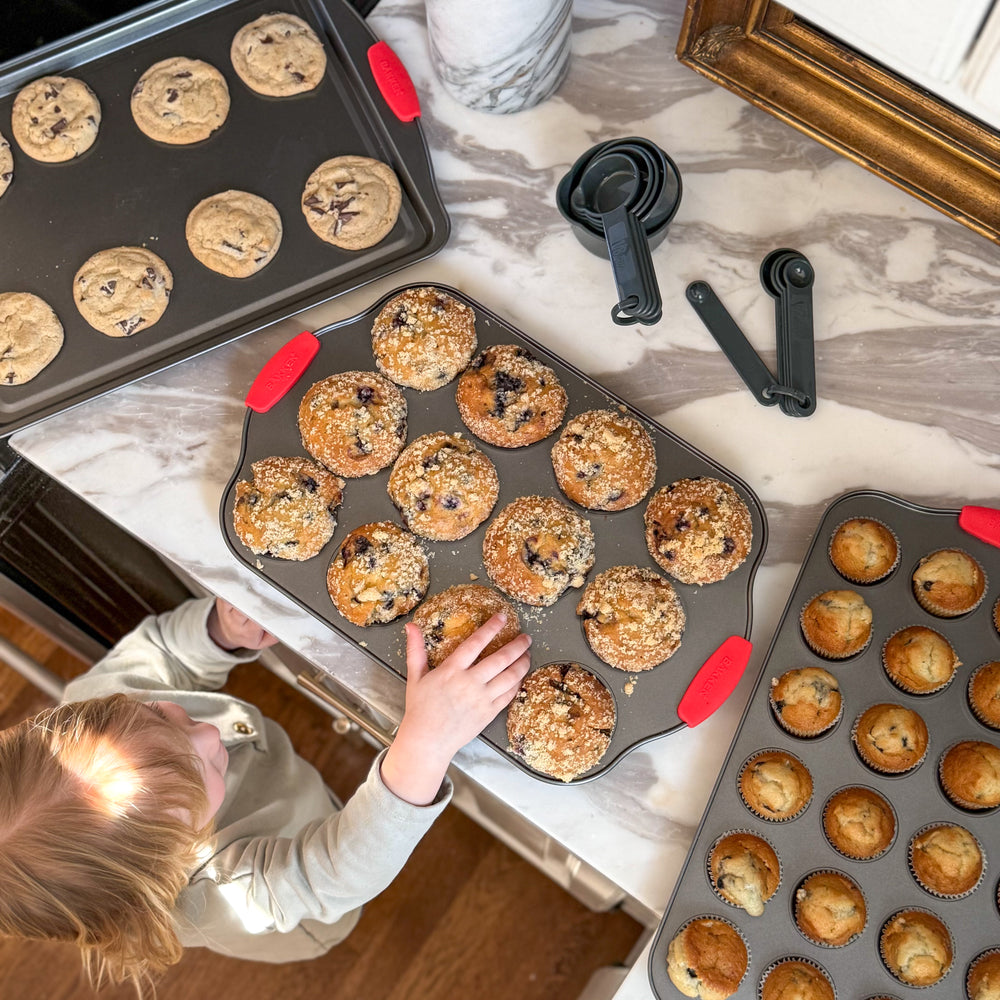
We'd rather be specific than loud. Our nonstick carbon-steel bakeware sets use coatings described as PFOA, PFOS and PTFE-free. The Crystal Kung Minkoff ceramic collection is listed as PTFE and PFAS-free. Our cast-iron Dutch ovens and griddles rely on enamel or seasoning rather than a nonstick coating. When a product page makes a claim, that's the claim we stand behind, and nothing broader.
The bottom line
You don't need to panic about the pan you already own, and you don't need to throw everything out at once. Use any nonstick pan at sensible heat, retire it when the coating is visibly breaking down, and when it's time to replace something, choose the material that fits how you cook. Clear labels, moderate heat and good care go a long way.
Sources
- U.S. EPA: PFAS Explained
- U.S. EPA (2015): EPA's Actions to Restrict PFOA and Similar Chemicals
- U.S. FDA: Authorized Uses of PFAS in Food Contact Applications
- American Cancer Society: Teflon and Perfluorooctanoic Acid (PFOA)
- German Federal Institute for Risk Assessment (BfR): Questions and Answers on PTFE Non-Stick Cookware
- StatPearls (NCBI Bookshelf): Polymer Fume Fever
- WPVI/6abc, reporting on Consumer Reports testing (2023): Why You Can't Always Trust Claims on Nontoxic Cookware
- WAFB, Consumer Reports (2026): Should You Break Up With Your Non-Stick Pans?