How to Bake Cookies That Don't Spread: 9 Tips

To bake cookies that don't spread, start with butter that is cool but soft, measure your flour by weight, and chill the dough for at least 30 minutes before baking. Then bake on a cool, ungreased cookie sheet lined with parchment, in an oven that is truly at temperature. Most flat cookies come down to warm dough, too little flour or a hot or greased pan.
Here is why cookies spread and the fixes that work, plus how your cookie sheet plays a bigger role than most recipes admit.
Why do cookies spread?
As cookie dough heats up, the butter melts and the dough starts to flow. At the same time, eggs and flour begin to set. A cookie keeps its shape when the structure sets before the butter has fully melted and run. Anything that makes the butter melt faster, or the structure set slower, means a flatter cookie.
Common culprits:
- Butter that is too soft, melted, or warmed by your hands
- Too little flour, often from scooping instead of weighing
- Extra sugar, which liquefies as it bakes
- Dough that sat at room temperature too long
- A greased pan, which gives dough something slick to slide on
- A warm cookie sheet straight from the last batch
- An oven that runs cooler than the dial says
9 ways to bake cookies that don't spread
1. Get the butter temperature right
"Room temperature" butter for cookies should be cool and pliable, around 65°F. It should hold a fingerprint when pressed but not look shiny or greasy. If your kitchen is warm, take it out only 30 to 45 minutes ahead.
2. Weigh your flour
Scooping a measuring cup straight into the bag can pack in extra flour, while fluffing and spooning can come up short. A kitchen scale removes the guesswork. King Arthur Baking lists a cup of all-purpose flour at 120 grams. If a recipe gives grams, use them.
3. Chill the dough
Chilling firms up the butter and gives the flour time to absorb moisture, so the dough holds its shape longer in the oven. Thirty minutes helps; a few hours or overnight helps more and deepens the flavor. Scoop the dough into balls first, then chill them, so you can bake straight from the fridge.
4. Bake on a cool sheet
Putting dough on a pan that just came out of the oven starts melting the butter before it even goes in. Rotate between two or three sheets, or cool a sheet under cold running water, dry it well, and then reload it.
5. Skip the grease, use parchment
Greasing a cookie sheet makes dough slide outward. On a nonstick sheet you rarely need extra fat. Parchment paper gives a little grip and makes cleanup easy. Silicone baking mats are handy, but some bakers find cookies spread slightly more on them than on parchment.
6. Check your oven temperature
Many home ovens run hot or cold. An inexpensive oven thermometer will tell you. If your oven runs cool, the cookies spend longer melting before they set. Let the oven preheat fully, then wait another 10 minutes.
7. Watch the sugar and leavening
More sugar, especially white sugar, and too much baking soda both encourage spread. Measure leaveners with level spoons, and check that your baking soda and baking powder are fresh.
8. Shape taller dough balls
Roll scoops a little taller than wide instead of flattening them. They will settle into a thicker round as they bake.
9. Give them room
Space cookies about 2 inches apart. Crowded cookies merge and trap steam, which keeps the edges from setting.
Quick troubleshooting table
| What you see | Likely cause | Try this |
|---|---|---|
| Thin, flat, greasy cookies | Butter too warm or melted | Use cool butter, chill the dough |
| Wide, lacy edges | Too much sugar or too little flour | Weigh ingredients, check the recipe |
| First batch fine, later batches flat | Warm cookie sheet | Rotate sheets or cool between batches |
| Cookies slide and merge | Greased pan or crowding | Use parchment, space 2 inches apart |
| Dark bottoms, pale tops | Dark pan or rack too low | Bake on the middle rack, lower heat by 25°F |
How your cookie sheet affects spread
Dark vs light sheets
Dark pans absorb more heat, so cookie bottoms brown faster. If you bake on a dark sheet and see dark bottoms before the tops are done, lower the oven by about 25°F and check a few minutes early.
Rimmed vs flat sheets
A flat or low-rimmed cookie sheet lets hot air move across the cookies evenly and makes it easy to slide them off. A rimmed sheet pan works too, and it is more versatile for roasting.
Size matters
A larger sheet means fewer batches and less waiting, but make sure it fits your oven with at least an inch of space on all sides for air to circulate.
What we bake on
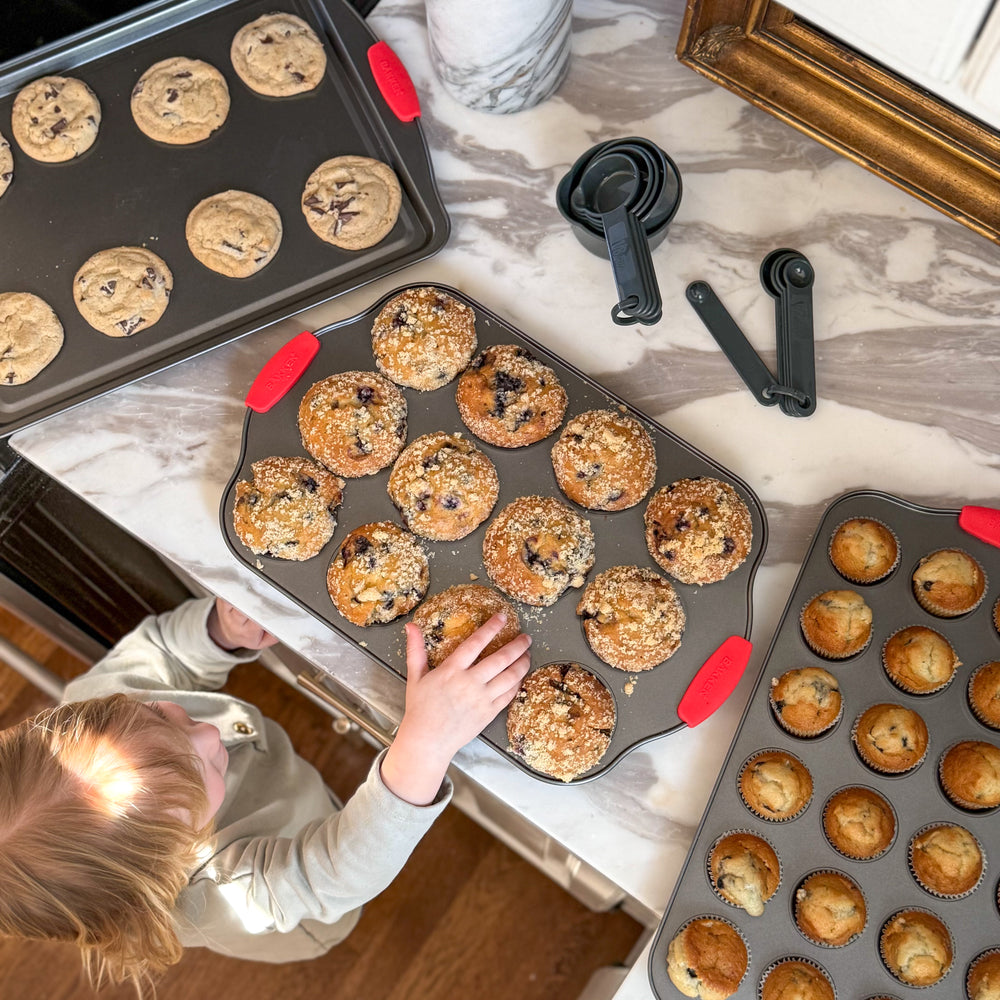
Our 3-Piece Cookie Sheet Set, Gray with Red Handles is 0.5 mm carbon steel with a nonstick coating, listed as free of PFOA, PFOS and PTFE, oven safe to 450°F, with red silicone handles. It comes in three sizes (13.18 x 8.66", 14.56 x 9.84" and 16.93 x 11.42"), which makes it easy to rotate sheets so you are always loading a cool one. If you only need one big pan, the Large Cookie Sheet is 17.10 x 11.88 x 0.60" with the same 0.5 mm carbon steel and 450°F rating.
Shop all of our cookie sheets.
Caring for your cookie sheets
- Let pans cool before washing to protect the coating.
- Hand wash with a soft sponge and mild soap, even if a pan is labeled dishwasher safe.
- Skip aerosol cooking sprays, which leave sticky buildup on nonstick surfaces.
- Use a silicone or nylon spatula to lift cookies, not metal.
- Dry fully before stacking, and put a paper towel between sheets if you nest them.
Building out a baking setup? A bakeware set can cover cookies, cakes, muffins and loaves in one go. Browse our bakeware sets, and see our baking pan guide for which pan to reach for with each bake.
A quick food safety note
It is tempting, but skip tasting raw cookie dough. Raw flour and raw eggs can carry harmful bacteria, so wait for the baked cookie.
Quick answers
How do I stop my cookies from spreading?
Use cool, pliable butter, weigh your flour, and chill the dough for at least 30 minutes. Bake on a cool, ungreased sheet lined with parchment in a fully preheated oven.
Does chilling cookie dough stop spreading?
Yes, it helps a lot. Cold butter melts more slowly in the oven, so the cookie sets before it can spread too far.
Should I grease my cookie sheet?
Usually not. Grease makes dough slide and spread. Use parchment paper, or bake directly on a nonstick cookie sheet.
Why are my cookies flat after the first batch?
The cookie sheet is probably still warm from the oven. Let it cool completely, or rotate between two or three sheets.